


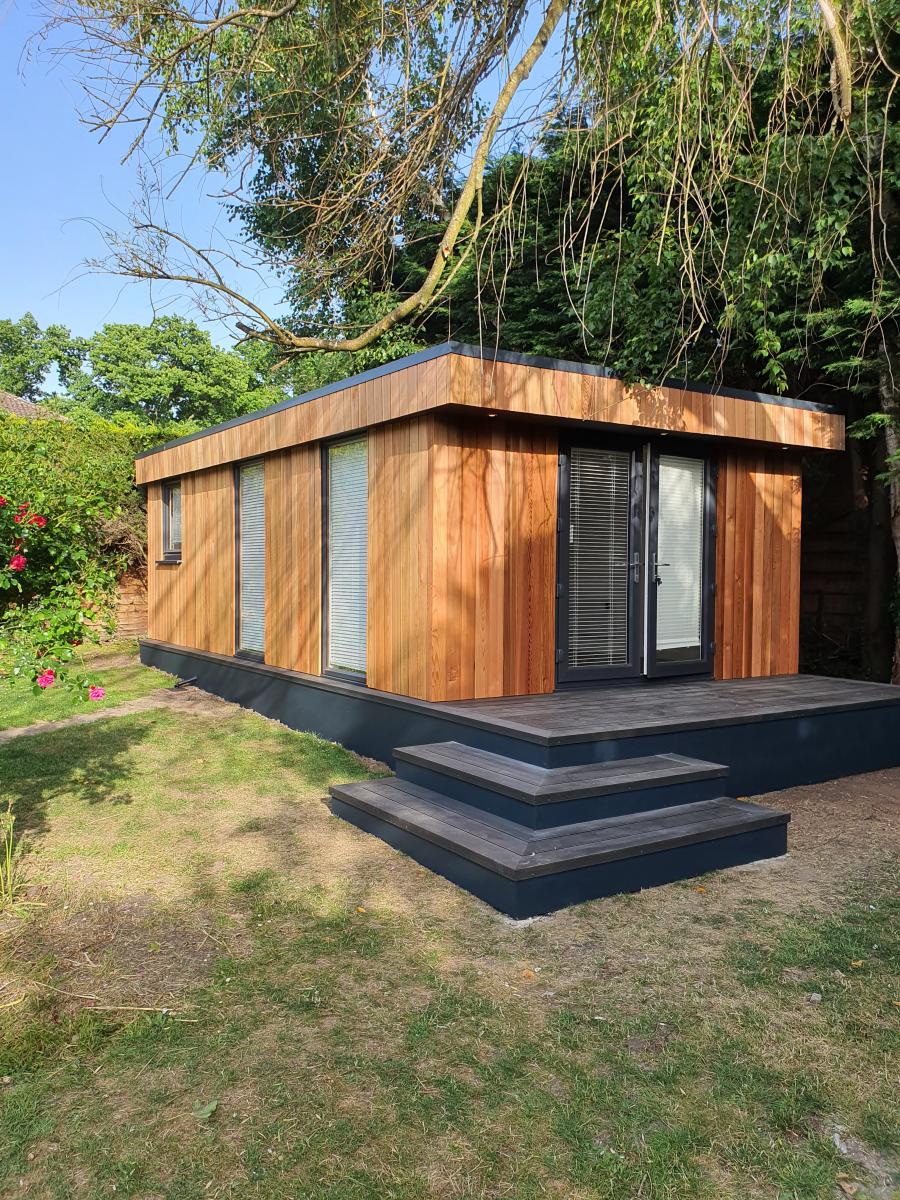
modular HOM3 cabin recently erected in Kensington by Business Interior Solutions as a dual garden office and art studio.
------------------------------------------------------------------------------

------------------------------------------------------------------------------

In a post-pandemic world, when reducing social isolation and loneliness and reconnecting with our communities once again is paramount, the Scottish Men’s Sheds Association (SMSA) is making a call for action for the government to continue to financially support the national hub of the Scottish Men’s Sheds Movement and men’s health and wellbeing.
The SMSA was formed in 2014 to create a new national health movement for men which did not previously exist in Scotland and share their unique Men’s Shed development pathway strategy to new groups. Since 2016, the Association has expanded into: Shed-specific tailored information such as policies and constitutions; mediation support; consultation with a hard-to-reach group; promotion of the work of the sector; discounts from SMSA partners for Sheds to reduce costs; sustainability strategy advice; co-production for the voice of men’s health in a variety of sectors and Cross-Party groups; and a national membership programme for its Shed Members and 3,000+ Individual Members.
The SMSA’s initial start-up funding was received from the Scottish Government in 2016 but unlike the successful developmental statutory support of the Australian and Irish governments for their respective Men’s Shed movements, ours has been reduced over the years and now stopped.
We have been successful in attracting other funders in recent years to cover this shortfall however require statutory funding as the demand for services and support increases immensely. Despite a meeting with Scottish Government where the SMSA Chief Executive, SMSA Chairman and SMSA Patron, Sir Harry Burns (the former Chief Medical Officer for Scotland) appealed for increased support for the charity and the movement, the decision was unfortunately made in February 2022 by three Ministers (proposed new trilateral funding strategy) to rather stop all statutory funding to the SMSA going forward in 2023.
Now is not the time to abandon and disinvest in this successful men’s health movement that is voluntarily engaging with and reaching men and changing and saving lives. These volunteers need our support now more than ever as evidenced by the ever-increasing growth in our membership.
As we near the 10-year anniversary of the opening of the first Men’s Shed in Scotland, we now celebrate over 200 open and developing Men’s Sheds groups across Scotland (in all 32 local authority areas) reaching and supporting 10,000+ men aged 18 or over. This year, we also welcomed the completion and findings of our four-year partnership with Glasgow Caledonian University’s research (£150,000) – Sheds for Sustainable Development Project.
Our three-year development plans (2023-2026) have taken into account this research and core statutory developmental funding is required if the movement is to not only continue to grow but remain sustainable for its volunteers and their health and wellbeing. We strongly believe that the current number of Men’s Sheds in Scotland (202) has only reached just under half (45%) of what it could be.
--------------------------------------


-------------------------------------------------------------------------

It's time for another in our semi-irregular Friday Finery series of posts. This week it's the atmospheric art studio belonging to artist and illustrator Sarah Harding, set in rural south Shropshire.
-------------------------------------------------------------------------


-------------------------------------------------------


An excellent piece in the Financial Times by Edwin Heathcote ('Office scenes of domesticity mask a few home truths') takes a swift look at the historical relationship between office and home. Here's a snippet, talking about the effects of the pandemic:
The boundary that might once have delineated home and work dissolved. And the strange thing about this is that it represents the exact opposite of what had been happening over the past couple of decades as the office attempted to convince us to hang around for longer, to chill, but to keep working, to treat it as a second home (one supercool co-working outfit adopted precisely that name).
Well worth a read.
---------------------------------


As I've mentioned before there are several writing sheds and huts in my recent book Rooms of Their Own (dare I say it, the ideal Christmas present for a loved one or even yourself as a special treat). Here is the section on John Steinbeck's, accompanied by the lovely illustrations by James Oses which appear throughout the book.
In a 1958 letter to his friend and agent Elizabeth Otis, American novelist John Steinbeck outlined his plans for building what he described as his “little lighthouse”, somewhere that was too small for a bed so that it could never be used as a guest room. “It will be off limits to everyone,” he told her. “One of its main features will be an imposing padlock on the door.”
Steinbeck’s writing hut on Long Island, New York, was so dear to him that he actually gave it a name, Joyous Garde (he even handmade a sign for it and stuck it above the door outside). Named for Sir Lancelot's castle, the hexagonal structure at Sag Harbor was inspired by Mark Twain's own garden office and enjoyed marvellous views over the cove near Bluff Point. The attractive hut with windows in every wall was built by Steinbeck himelf and he worked in a director's chair inside which he labelled 'Siege Perilous' – indeed, Joyous Garde had only one chair so visitors had nowhere to sit down. A large desk took up much of the room allowing him to spread out papers and books and a bookshelf ran all round the room over the windows. In this cosy abode, which he initially planned to call Sanity’s Stepchild, he wrote his travelogue Travels with Charley and his final novel Winter of Our Discontent.
As well as Joyous Garde, Steinbeck (1902 – 1968) enjoyed the peace of his writing room in his apartment on the upper East Side of New York which he described as “a quiet room where nothing ever happens”, so quiet in fact that he talked about getting a myna bird and teaching it to ask him questions. He had a sign on the outside of the door which read ‘Buzzard’s Despair’ and on the reverse ‘Tidy Town’ which is how his wife adjusted it to show she had been in and tidied it while he was out. A keen builder all his life, he used the same room to build a kayak-like boat.
But whichever writing room he worked in, Steinbeck – who liked to write rapidly - had one prerequisite. Pencils. And plenty of them.
“I like the feeling of a pencil,” he said, which is something of an understatement. He used hundreds on each new book, sharpened to a point which he son Thom called ‘surgical’. “The pure luxury of long beautiful pencils charges me with energy and invention,” said Steinbeck.
He was particularly keen on round ones, as he found hexagonal pencils cut into his fingers. Nevertheless, he wrote with them so often that he developed a grooved callus on his finger where the pencil rested. Another requirement was that they be black so that they did not distract him.
Steinbeck also had an electric sharpener of which he was very fond, calling it his most used and most useful possession. Since he began each morning with a wooden box of 24 fully sharpened pencils which he rotated and resharpened during the day, it was certainly a great help. As one began to blunt after a few lines, it would be placed into a second box to await resharpening while he picked up a new pencil to continue writing. As the process continued, the pencils would shorten and once the metal holding the rubber on the top touched his hand, he would hand them over to his sons.
“For years I have looked for the perfect pencil. I have found very good ones, but never the perfect one. And all the time it was not the pencils but me. A pencil that is all right some days is no good another day.” Had soft writing days and hard writing days, according to pencils. Sometimes it changed in the middle of the day. Super soft pencils didn’t use very often as “must feel as delicate as a rose petal to use them”
Favourite brands included the Blaisdell Calculator 600, the Eberhard Faber Mongol 480 (actually yellow), the Eberhard Faber Blackwing 602 (tagline ‘half the pressure, twice the speed’). Bought four dozen pencils at a time. When the metal of the rubber on the pencil touched his hand, he discarded it to make way for a new one.
Steinbeck acknowledged that this love of pencils, what he called his “pencil trifling”, was one of his eccentricities. But he had others. He wrote his novel East of Eden on the right hand pages of a book (in pencil, naturally), while using the left hand ones to compose letters to his friend and editor, Pascal Covici about the progress of the book, as well as general news, what his family was up to. In fact he started his morning work with the letter to warm up - Steinbeck explained he felt the need to ‘have to dawdle a certain amount before I go to work.’
Despite this low-tech obsession, Steinbeck was actually keen to make use of new technology, using a Dictaphone to try out dialogue for his novels, and typing up manuscripts on his olive green Hermes Baby typewriter, one of the earliest portables. On its case he scratched ‘The Beast Within’.
------------------------------------------------------------------------------


